
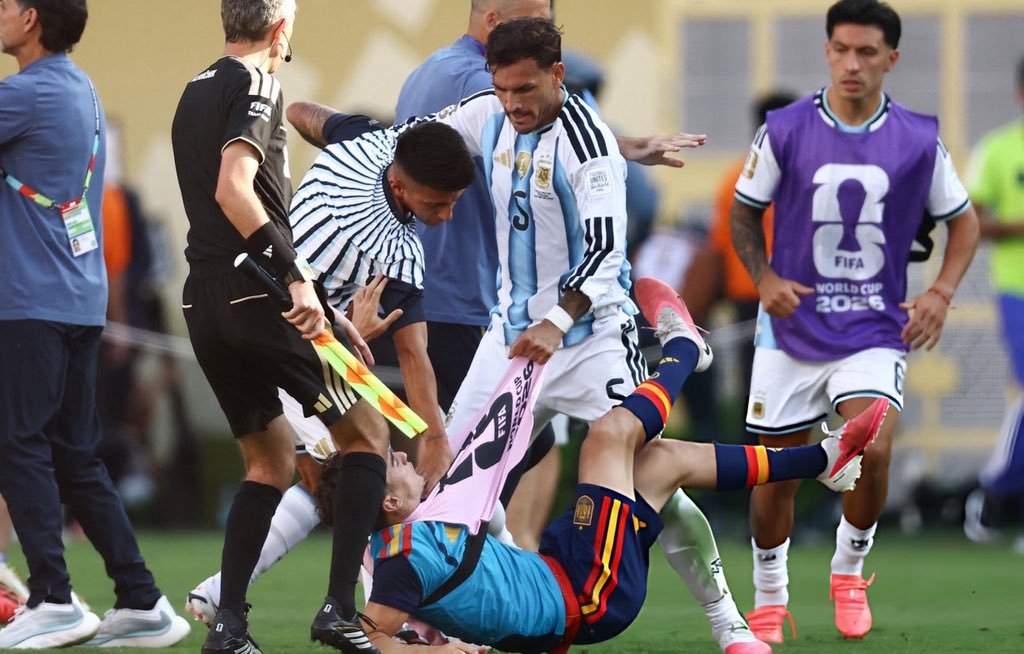
Argentina, moments after delivering one of the worst performance of a World Cup finalist, proved that they are capable of worse after turning Spain’s celebrations into chaos as their true attitudes finally took over.
The final whistle blew in East Rutherford, and Spain had won the World Cup, but what the world wasn’t expecting was the behavior of Argentine players, even though the world knew it was what they were always capable of.
The full-time scenes that followed the final whistle at the 2026 World Cup final will stay longer in people’s minds, and it wasn’t about the trophy lifting; it was what came right after, with Argentina throwing punches instead of shaking hands.
Leandro Paredes grabbed Gavi, threw him to the ground, and shoved a hand in his face while still holding his bib. Before that, he’d already gone for Eric Garcia’s throat, while Argentina’s own coach, Lionel Scaloni, had to jog onto the pitch to pull his players apart.
Somewhere in the chaos, Nahuel Molina took a swing too. It was a disgraceful scene, but not surprising because even as winners, Argentina haven’t been graceful in their conducts.
From taunting their opponents at the last World Cup edition, including against France in the final, to England in this semi-final, with Enzo Fernandez’s provocative celebrations and teammates celebrating in the face of Jude Bellingham and others, but the world choose to unsee these incidents.
But against Spain, where they weren’t even provoked after losing, they lost their heads. The Spaniards were celebrating on their own pitch, in front of their own fans, and Argentina, being true to who they really are, turned it into a fight.
Argentina Being Bullies: A Pattern, Not an Accident
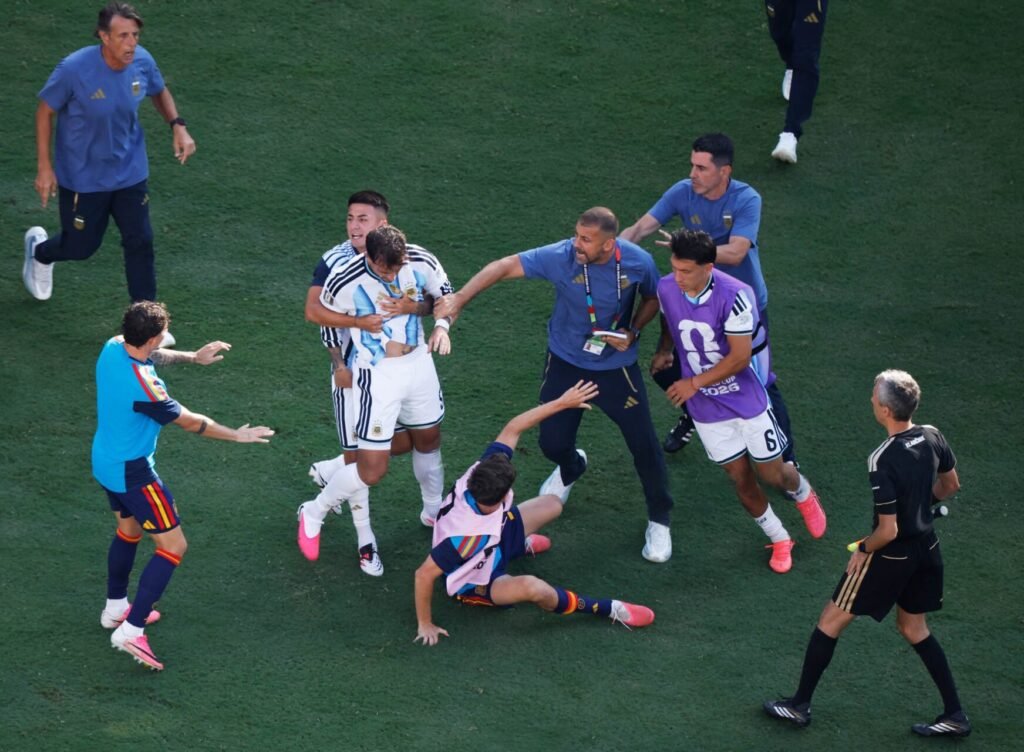
The instinct is to write this off and think of Paredes and co. as players losing their temper in the heat of the moment. However, look back over the tournament and it’s hard to call it a one-off. This is who they really are.
Spain defender Aymeric Laporte raised the same complaint before a ball had even been kicked in the final. Speaking to Marca, he said he’d watched recent matches and seen things that genuinely surprised him, rough challenges going completely unpunished.
He named Argentina directly, saying they’re a side that likes to leave something on you physically, and argued referees needed to get a grip on it before one or two players dragged the whole match into chaos.
He wasn’t wrong. The last nine cards of the 2026 World Cup edition were awarded to Argentina players, three against England and six against Spain, whereas up until the semi-finals, they received just six bookings for a tournament high 86 fouls.
In the same breath, Laporte made a point of saying Spain hadn’t played that way once all tournament. But that wasn’t a rival being bitter after a loss. It was a warning, delivered days in advance, and it turned out to be spot on.
Even Their Own Admirers Now See It
What makes it harder to shrug off is that even people who admire Lionel Messi personally aren’t denying it. Barcelona president Joan Laporta was asked before the final to compare the two sides, and didn’t dodge the question.
His answer was blunt, stressing that Argentina plays with more aggression, and Spain plays more as a collective unit. Laporta has spent years singing Messi’s praises, so it’s not a small thing when he says that.
He went further too, suggesting Spain’s real challenge wasn’t Argentina’s football at all, but whether the referee had the nerve to actually impose himself on the game.
For a moment, think about what that implies. A man close to the sport, close to Messi, was essentially saying beforehand that everyone expected Argentina to get away with things, unless someone stopped them.
Hiding Behind the Lionel Messi Halo
The heart of the problem is that none of Argentina’s aggression is hidden. It is caught in play. It’s in the disciplinary numbers. It played out in front of a global TV audience minutes after full-time. And still, the conversation drifts back to Messi’s brilliance instead of the teams’ conduct.
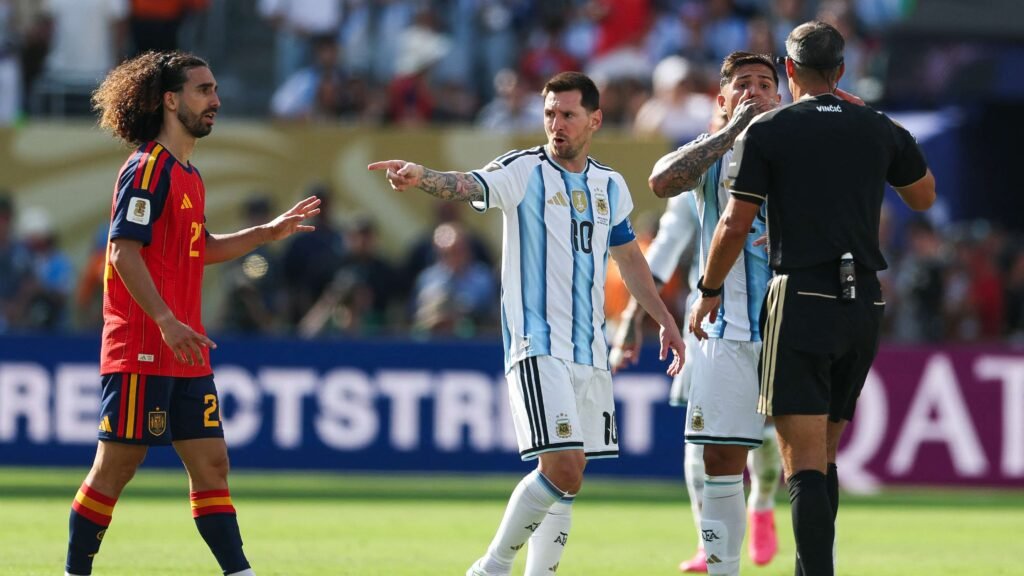
That’s not accidental, because the love for Messi’s talent has become a kind of cover. Commentators who’d rip apart any other nation for a mass scuffle suddenly reach for words like passion and heart.
A reckless tackle becomes fighting spirit the second an Argentina shirt is involved. Loving one player has made people uncomfortable saying the obvious out loud: this team plays close to the line, and it keeps getting away with it.
But even the eight-time Ballon d’Or winner showed he isn’t unlike his teammates. During the sending off of Enzo Fernandez, Messi was involved in a light chat with Marc Cucurella, but because the Spanish left-back touched his lips, he called for a VAR check to have the new Real Madrid man sent off. How embarrassing.
And after the storm had calmed, the team also collectively turned their backs toward the podium as the Spanish squad was crowned world champions and hoisted the trophy.
Pundits have heavily criticized the squad for a complete lack of class, noting that they seemingly refused to acknowledge Spain’s victory.
Furthermore, when Rodri was presented with the Golden Ball tournament MVP award, the collective group turned away while Argentinian fans loudly chanted Lionel Messi’s name in protest.
Ultimately, this bitter display shattered the illusion of humility the Albiceleste so carefully projected in previous triumphs. They exposed a glaring double standard that they are a side that can only counterfeit class when holding the trophy, but completely lack the grace to show it in defeat.
The Mask Has Finally Slipped off Pretence
None of this started with the defeat to Spain. Albiceleste have spent years being sold as a team of humility and unity, a squad that carried itself with grace even in its most dominant moments.
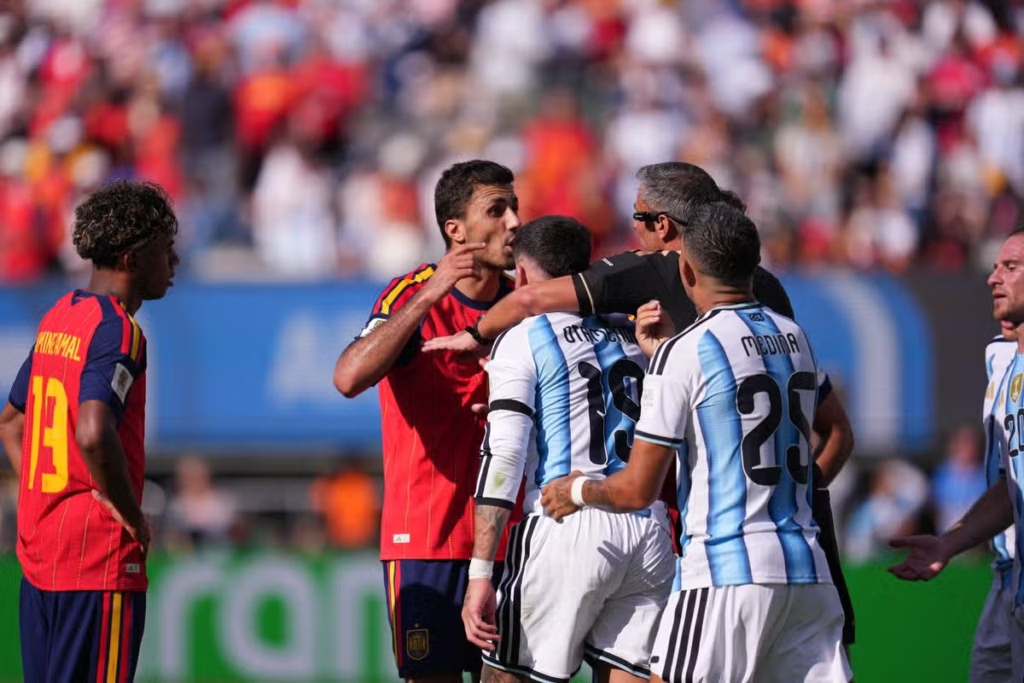
However, Sunday night’s scene after they had been handed harsh football lessons exposed how much of that image was built on winning rather than on genuine character.
Strip away the trophies and the results, and what’s left is a team that brutalizes their opponents beyond permitted on the lawbooks, and couldn’t accept a fair defeat with any dignity.
None of these were isolated moments of frustration, they were but glimpses of an entitlement that’s been there all along, just never tested by a loss this big. That’s really what made Sunday different.
This Argentina team have lost before, but rarely like this, and rarely with so little left to hide behind. No Messi magic to distract from it, and no trophy to paper over it. Just a team forced, for once, to be seen exactly as they are.
Whether people choose to keep excusing it going forward is another matter. But after Sunday, nobody can pretend they didn’t see it clearly for what it was.
Kehinde-Hassan Afolabi

1 Comment
Lol