
By Kehinde-Hassan Afolabi
Nigeria’s remarkable record across youth tournaments underlines its status as one of Africa’s most successful football nations, but flawed development pathways continue to prevent the country from fully realising its extraordinary talent potential.
Nigeria’s football greatness is sometimes discussed as though it belongs to a distant past, but the country’s record tells a different story.
From dominating youth competitions to breaking barriers at the Olympics and consistently challenging for continental honours, few African nations have contributed as much to the development and history of the game.
The latest evidence is still news, as the Flamingos defeated Japan 2-1 in Rabat to win the FIFA U-17 Women’s World Cup. It was Nigeria’s first title in the competition and made the country the first African nation to lift the trophy.
More importantly, it completed a remarkable piece of history for the country, who became the first country from Africa to win both the Men’s and Women’s U-17 World Cups, as well as just the second in the world, after France.
But this achievement should not be viewed in isolation. It is another addition to a collection of records that raises a bigger question of if Nigeria is Africa’s greatest football institution?
Consider the evidence.
Nigeria became the first African nation to win the FIFA men’s U-17 World Cup in 1985, when the Golden Eaglets conquered the inaugural tournament in China. They have since won the competition five times, in 1985, 1993, 2007, 2013 and 2015, making them its most successful nation.
They have also reached the final eight times, another record that underlines their remarkable consistency at youth level.
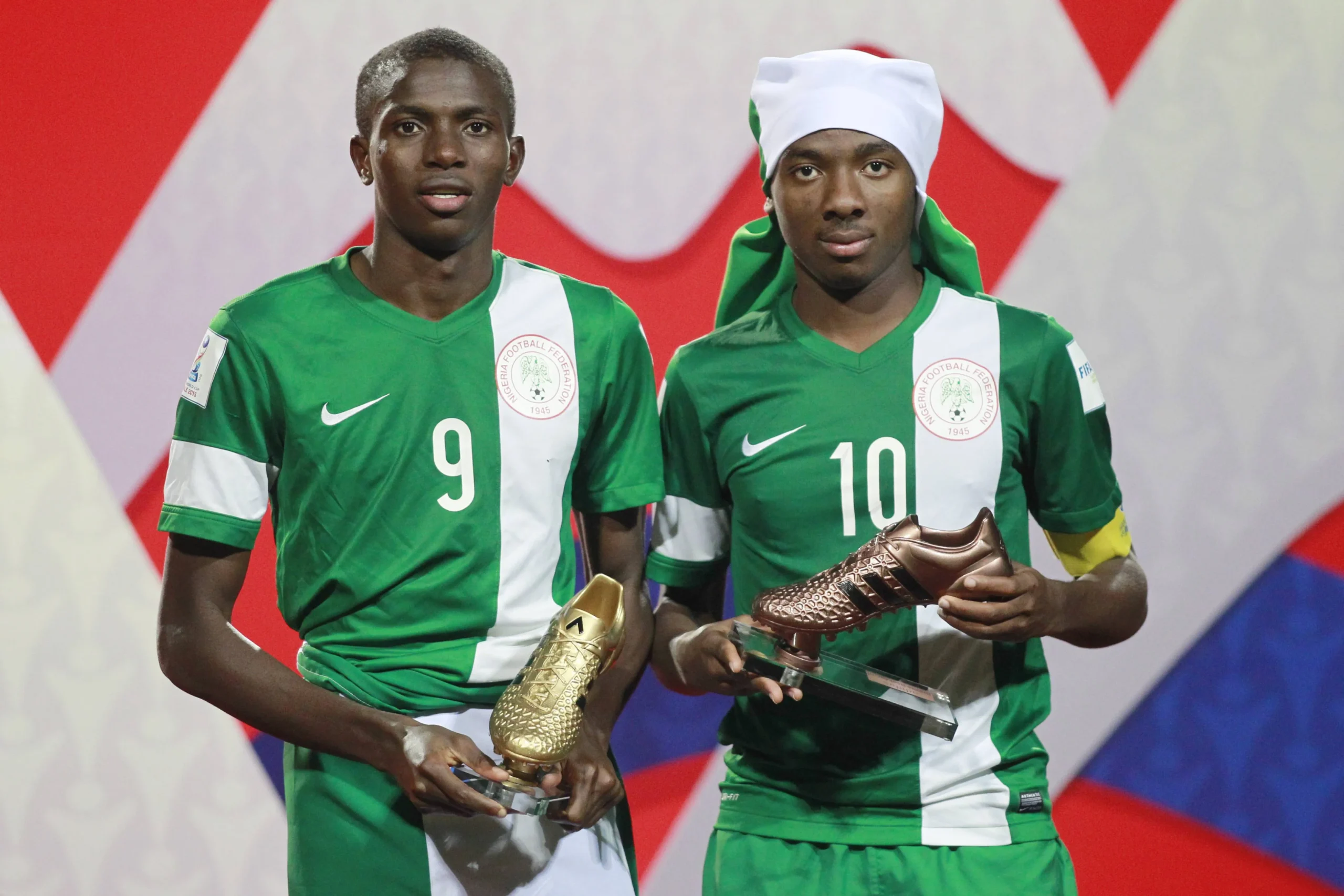
The country’s individual achievements are equally impressive. Victor Osimhen scored a tournament-record 10 goals at the 2015 edition, while Sani Emmanuel, Kelechi Iheanacho and Kelechi Nwakali each won the competition’s Golden Ball in 2009, 2013 and 2015 respectively.
Three different Nigerian players claiming the tournament’s top individual honour across those editions is further evidence of the country’s ability to produce outstanding young footballers, especially at a stage where their African counterparts would consider fortune to make appearance once.
Nigeria’s influence, however, extends beyond age-grade football.
In 1996, the Super Eagles became the first African team to win Olympic football gold, defeating Argentina 3-2 in a memorable Atlanta final after conquering prime Brazil in a dramatic semi-finals that finished 4-3.
They subsequently added silver in 2008 and bronze in 2016, becoming the only African country to collect all three colours of Olympic football medals in the men’s competition.
At senior international level, the Super Falcons have established another remarkable legacy. With 11 Women’s Africa Cup of Nations titles, Nigeria remain the competition’s most successful nation, maintaining a dominance that has lasted across generations.
Even the Super Eagles’ achievements deserve more appreciation. Three Africa Cup of Nations titles, five runners-up finishes and nine third-place finishes give Nigeria 17 podium appearances, the highest total in the competition’s history.
They also reached fifth in the FIFA Men’s world rankings in April 1994, the best position ever achieved by an African nation at the time. Recently equalled by Morocco during the World Cup in the summer.
These are not isolated moments of success, but evidence of a football culture that has consistently produced exceptional players across generations.
The talent has never been a problem
Perhaps the most interesting aspect of Nigeria’s football story is the contrast between its extraordinary success at youth level and the inconsistency of its senior men’s national team.
The Golden Eaglets’ five world titles, the Flamingos’ historic breakthrough and the Super Falcons’ continental dominance cannot be dismissed as coincidences. They point towards a deeper reality that Nigeria has an exceptional talent pool, one capable of competing with and defeating the best footballing nations when given the right platform.
The problem is what happens afterwards.
Too many promising Nigerian footballers struggle to make the transition from age-grade competitions to established senior careers.
Some are poorly managed, others lack access to quality coaching and competitive environments due to transition troubles, while inadequate infrastructure, inconsistent administration and the absence of sustainable development pathways have repeatedly undermined their progress.
It would be unfair to blame every senior-level disappointment on circumstances outside the players’ control. Nevertheless, the failure to consistently translate Nigeria’s enormous footballing potential into senior international success is as much a structural problem as it is a sporting one.
The Super Eagles’ struggles, including their failure to qualify for the 2026 FIFA World Cup, should therefore provoke questions beyond the performances of individual players. A country capable of producing world champions at youth level should have a much stronger system for preparing those players for the demands of senior football.
Nigeria does not need to discover another generation of footballers as much as it needs to learn how to develop the ones it already has.
Why investors should be looking towards Nigeria
There is also an enormous opportunity here for international investors, football clubs, scouts and academy operators, and the country should be one of the first destinations considered by anyone looking to establish a football academy or build a sustainable talent-development network in Africa.
The country’s record provides an extraordinary starting point. Its young players have repeatedly demonstrated the technical ability, athletic qualities, creativity and competitive mentality required to succeed internationally.
What makes this even more remarkable is that these achievements have come despite the country’s economic difficulties, inadequate sporting infrastructure and persistent administrative challenges.
Imagine what could be achieved with if the preparation for these talents is on level ground with those in developed countries.
For investors, the opportunity is not simply about doing Nigerian football a favour. It is also a potentially rewarding sporting and commercial investment, because developing young players create value through professional transfers, international partnerships and the discovery of talents who might otherwise go unnoticed.
The players deserve better opportunities, while investors stand to benefit from a talent pool that has repeatedly demonstrated its incredible potential.
Nigeria’s greatness deserves a better system
So, is Nigeria Africa’s greatest football institution?There is certainly a compelling argument. No other African nation can match the combination of Men’s U-17 world titles, the historic Olympic football achievement, the Super Falcons’ continental dominance and the country’s record of AFCON podium finishes.
But greatness should not only be measured by trophies accumulated in the past. It should also be reflected in the ability to sustain success, develop generations of players and build institutions capable of delivering consistently.
Nigeria already has the raw materials, and in Morocco, the Flamingos provided yet another reminder, while the Golden Eaglets and Super Falcons have spent decades reinforcing the same message.
The next challenge is to ensure that the country’s football administration, investors, clubs and development structures finally match the extraordinary ability of its players. Nigeria does not have a shortage of football talent. But it does have a shortage of systems capable of fully unlocking it.
And until that changes, the country may continue producing world beaters at youth level while wondering why so many of them never fulfil their potential at the very top.
The unsung heroes building Nigeria’s football future
Nigeria’s football future is not being left entirely in the hands of government. Several former and current Super Eagles stars are helping bridge the gap through private initiatives.
Odion Ighalo has established a football academy in Epe, while Taiwo Awoniyi’s foundation is investing in grassroots talent identification and the Kwara Kiddies League. Joseph Yobo has also championed an academy combining football development with education, while Victor Agali runs an academy in Badagry.
Ahmed Musa has equally supported grassroots coaching and talent development through football clinics in Kano.
Their contributions, alongside independent academies and private investors, deserve recognition as they are helping ensure that Nigeria’s next generation has opportunities to be discovered and developed.
The talent is there, and the evidence is undeniable. So one might say it is high time the structure and infrastructure caught up.
