

La Liga to unveil fully automated offside technology in 2026-27 campaign
A monumental innovation is set to be paraded in the 2026-27 La Liga season as the stakeholders of the Spanish top-flight league have agreed to kick off the use of fully automated offside technology when the new season gets underway.
This is a much welcome development in La Liga, which has become one of the most controversial leagues in Europe, as the top teams have gone from winning with exciting tactical play to whining with boardroom complaints when things haven’t gone their way.
The controversies have been nonstop, and it looms large every gameweek, even extending to the Champions League in recent weeks, when Barcelona could not accept their quarter-final elimination at the hands of Atlético Madrid.
What is changing in La Liga?
La Liga currently uses the semi-automated offside technology, but due to its shortcomings and the potential of integrating a system that limits errors due to human interference, the league has decided to take a step forward.
Features of the Fully Automated Offside System
As confirmed by the league’s president Javier Tebas, this innovation will involve a microchip inside the ball directly linked to the cameras set up by the referees to detect offside positions and immediately inform the referee if a player is offside.

Tebas also explicitly stated his dissatisfaction with the semi aspect, noting that current systems sometimes struggle with high player density and still occasionally require VAR officials to manually draw lines when the technology fails to differentiate between players.
Additionally, the decisions will also be made in a matter of seconds, eliminating the amount of time wasted on stoppages for decisions that would take minutes with the semi-automated technology.
This will also translate into fewer VAR delays, more accurate calls, and a faster flow to the game, similar to what we’ve already seen at the 2022 FIFA World Cup in Qatar and in the UEFA Champions League.
High-Frequency Optical Tracking
Imagine a network of 12 to 29 specialized tracking cameras tucked high beneath the stadium roof. Unlike the cameras capturing the drama for TV, these are specialists, dedicated solely to following the ball and the players.
They don’t just see players as shapes, they track 29 individual points on each person’s body, focusing on the limbs and extremities that can legally score a goal.

By capturing this data 50 times per second, the system maintains a living, skeletal 3D map of every player’s position in real time, helping officials make instant, correct calls.
The Integrated Smart Ball
The real heartbeat of this new era is the Smart Ball, which features a suspended 14-gram Inertial Measurement Unit (IMU) sensor at its center.
While the cameras capture 50 frames per second, this sensor transmits data at 500 times per second (500Hz), a high frequency allows the system to detect the exact vibration of a foot or any part of the body striking the ball.
By pinpointing the kick point with millisecond accuracy, it eliminates the human error often found in manual frame selection, where a ball might have moved several feet between two standard video frames.
Data Fusion and Automated Alerts
This software acts as the brain of the operation, instantly merging the 500Hz ball contact data with the 50Hz skeletal tracking data, so that whenever the sensor detects a pass, the AI immediately calculates the positioning of the attacker relative to the defenders.
Speed: If an offside position is detected, an automated alert is sent to the Video Operation Room, helping the officials reach not only an accurate but a quick decision.
Human touch: While a human VAR still monitors the output to ensure the system hasn’t tracked a non-active player.
Efficiency: The manual line-drawing phase is removed in this system, thus reducing the decision-making time from minutes to a matter of seconds.
Transparent 3D Visualizations
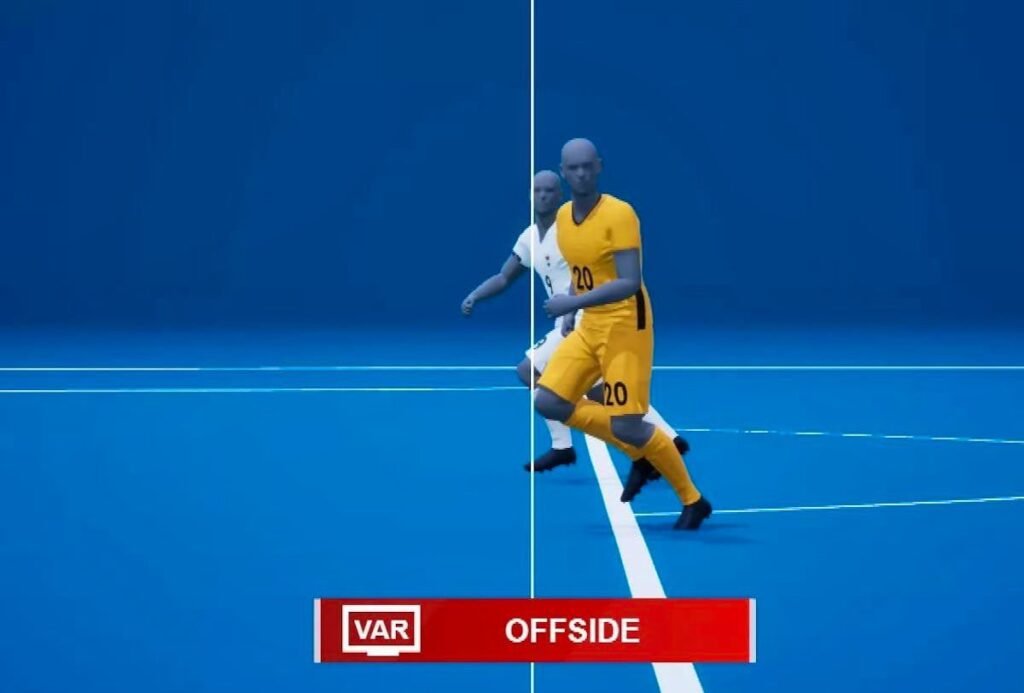
To ensure fans aren’t left in the dark, the system automatically generates a 3D animation using the exact same data points used to make the call.
This isn’t just a replay but also a definitive render that shows the offside line from the most revealing angle. These visuals are shared with broadcasters and stadium big screens almost immediately.
This transparency aims to take the mystery out of VAR, replacing the frustration of wonky manual lines with a clear, objective, and data-driven view of the truth that a player was truly offside.
A welcome development in the Spanish league
The timing of this technological leap could not be more critical for La Liga, which has recently devolved into a theater of boardroom grievances, where tactical brilliance is frequently overshadowed by post-match litigation and official complaints.
With the trio of Real Madrid, Barcelona, and Atlético Madrid increasingly vocal about perceived biases, the introduction of this fully automated offside technology acts as a vital peace treaty.

By removing the semi from the equation, La Liga is finally stripping away the human layer that fueled suspicions of subjectivity. This movement isn’t just about technical accuracy, it is about restoring the integrity of a competition where the discourse has become toxic.
For a league teetering on the edge of a credibility crisis, this automation provides a definitive stop-clock on controversies, forcing the focus back where it belongs, which is the pitch rather than the VAR room.
Kehinde-Hassan Afolabi
